Traditional Hymns
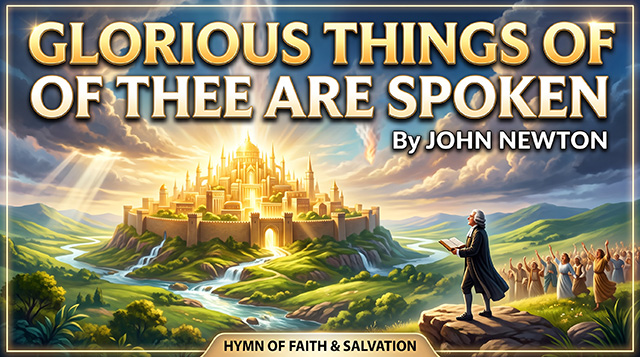
Glorious Things of Thee Are Spoken
Glorious Things of Thee Are Spoken
Listen to:
 Glorious Things of Thee Are Spoken Piano (.mp3)
Glorious Things of Thee Are Spoken (.midi)
Glorious Things of Thee Are Spoken (.mp3)
Glorious Things of Thee Are Spoken Bells Version (.mp3)
1. Glorious things of thee are spoken, Zion, city of our God; God, whose word cannot be broken, formed thee for his own abode. On the Rock of Ages founded, what can shake thy sure repose? With salvation's walls surrounded, thou mayst smile at all thy foes.
2. See, the streams of living waters, springing from eternal love, well supply thy sons and daughters, and all fear of want remove. Who can faint while such a river ever will their thirst assuage? Grace which like the Lord, the giver, never fails from age to age.
3. Round each habitation hovering, see the cloud and fire appear for a glory and a covering, showing that the Lord is near! Thus deriving from our banner light by night and shade by day, safe we feed upon the manna which God gives us when we pray.
4. Blest inhabitants of Zion, washed in our Redeemer's blood; Jesus, whom our souls rely on, makes us monarchs, priests to God. Us, by his great love, he raises, rulers over self to reign, and as priests his solemn praises we for thankful offering bring.
Video so you can sing along to Glorious Things of Thee Are Spoken
Story of the hymn Glorious Things of Thee are Spoken
"Glorious Things of Thee Are Spoken" is a hymn by John Newton (1725-1807), the same writer who composed "Amazing Grace". It first appeared in the 1779 collection "Olney Hymns", which Newton prepared with his friend and neighbour, the poet William Cowper.Background and Composition
Newton served as curate (and effectively the pastor) of the parish church in Olney, Buckinghamshire, from 1764 to 1779. During those years he and Cowper collaborated on hymns intended for local services and prayer meetings. Newton often wrote a new hymn to accompany the evening Scripture lesson. "Glorious Things of Thee Are Spoken" was one of these. Manuscript evidence shows Newton used it at an informal service in Olney on Easter Sunday, 16 April 1775. Its original title was "Zion, or the City of God". The hymn draws mainly on Psalm 87:3 ("Glorious things are spoken of thee, O city of God") and Isaiah 33:20-21, which describe Zion as a secure dwelling place established by God. Newton originally wrote five stanzas of eight lines each. Later hymnals often print only three or four of them.Context in Newton's Life
Newton's own dramatic story of conversion from slave-ship captain to evangelical minister gives the hymn added depth. After years at sea and involvement in the slave trade, a violent storm in 1748 led him to pray and begin a long process of spiritual change. He eventually left seafaring, studied for the ministry, and was ordained in the Church of England. At Olney he became known for warm, practical preaching and for the close partnership with Cowper that produced the "Olney Hymns". The collection contains 348 hymns in total (about 280 by Newton and 68 by Cowper). "Glorious Things of Thee Are Spoken" stands out as one of the more joyful and confident pieces in the book. It celebrates the church as the spiritual Zion: a city founded on the Rock of Ages, watered by streams of living grace, and protected by God's unbreakable word.Tune and Later Use
The text is most often sung to the tune "Austria" (also called "Austrian Hymn"), adapted from a melody Joseph Haydn wrote in 1797 for the Austrian imperial anthem "Gott erhalte Franz den Kaiser". Other tunes, including "Abbot's Leigh" by Cyril Vincent Taylor (1941), have also been used. The hymn has remained popular in English-speaking churches for more than two centuries and continues to appear in many denominational hymnals.