Traditional Hymns
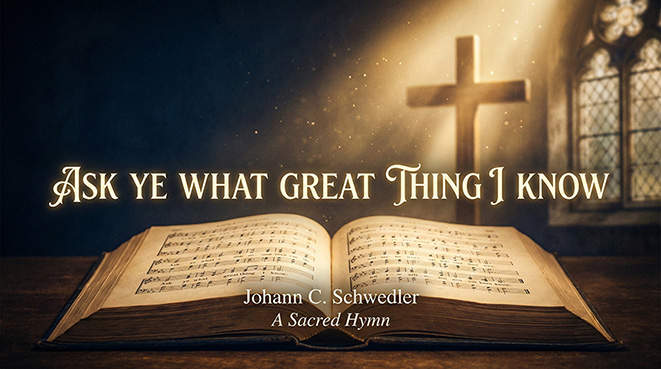
Ask Ye What Great Thing I Know
Ask Ye What Great Thing I Know
Listen to:
 Ask Ye What Great Thing I Know (.midi) Ask Ye What Great Thing I Know (.mp3) Ask Ye What Great Thing I Know Bells Version (.mp3)
1. Ask ye what great thing I know, that delights and stirs me so? What the high reward I win? Whose the name I glory in? Jesus Christ, the crucified.
2. Who defeats my fiercest foes? Who consoles my saddest woes? Who revives my fainting heart, healing all its hidden smart? Jesus Christ, the crucified.
3. Who is life in life to me? Who the death of death will be? Who will place me on his right, with the countless hosts of light? Jesus Christ, the crucified.
4. This is that great thing I know; this delights and stirs me so: faith in him who died to save, him who triumphed o'er the grave: Jesus Christ, the crucified.
The Story of the Hymn "Ask Ye What Great Thing I Know"
The hymn "Ask Ye What Great Thing I Know" is a profound declaration of faith centered on the crucifixion of Jesus Christ. Its original German title is "Wollt ihr wissen, was mein Preis?" (roughly "Do you want to know what my prize is?"), written by Johann Christoph Schwedler (1672–1730), a Lutheran pastor in Silesia (now part of Poland and Germany).Schwedler was born on December 21, 1672, in Krobsdorf, the son of a farmer and local magistrate. He studied theology at the University of Leipzig, earning his M.A. in 1697. In 1698, he became assistant minister at Niederwiese (near Greiffenberg), and by 1701, he was the full pastor there, serving until his death in 1730. He was renowned as a powerful preacher and man of prayer—services sometimes lasted from early morning until afternoon, with worshipers rotating in relays due to his popularity.
Schwedler was also a humanitarian: he founded an orphanage in Niederwiese. A prolific hymnwriter, he authored around 500 hymns, many focused on God's grace through Christ and the joy of salvation. He was friends with figures in the Pietist movement, including Count Nikolaus von Zinzendorf, founder of the renewed Moravian Church.
The hymn was published posthumously in 1741 in the Hirschberger Gesangbuch. Inspired by biblical passages like 1 Corinthians 2:2 ("I determined not to know anything among you except Jesus Christ and him crucified") and Galatians 6:14 (boasting only in the cross), it uses a question-and-answer format to emphasize that Christ crucified is the ultimate source of delight, hope, consolation, and victory.