Traditional Hymns
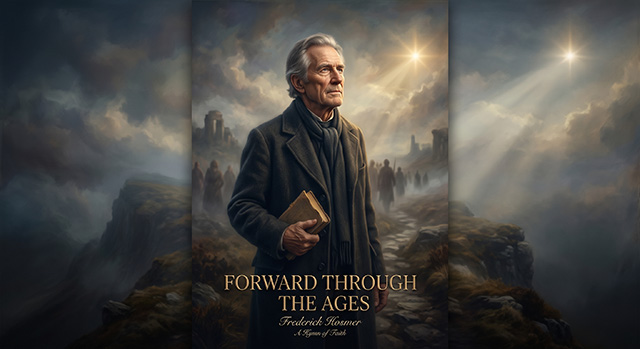
Forward Through the Ages
Forward Through the Ages
Listen to:
 Forward Through the Ages (.midi) Forward Through the Ages (.mp3) Forward Through the Ages Bells Version (.mp3)
1. Forward through the ages, in unbroken line, move the faithful spirits at the call divine; gifts in differing measure, hearts of one accord, manifold the service, one the sure reward.
Refrain: Forward through the ages, in unbroken line, move the faithful spirits at the call divine.
2. Wider grows the kingdom, reign of love and light; for it we must labor, till our faith is sight. Prophets have proclaimed it, martyrs testified, poets sung its glory, heroes for it died. (Refrain)
3. Not alone we conquer, not alone we fall; in each loss or triumph lose or triumph all. Bound by God's far purpose in one living whole, move we on together to the shining goal. (Refrain)
Story of the hymn Forward Through the Ages
"Forward Through the Ages" was written in 1908 (or possibly 1908–1909) by Frederick Lucian Hosmer (1840–1929), a Harvard-trained Unitarian minister and one of the leading American hymn writers of his era.Hosmer was born in Framingham, Massachusetts. He graduated from Harvard College in 1862 and from Harvard Divinity School in 1869, then served Unitarian congregations in places including Northborough, Massachusetts; Quincy, Illinois; Cleveland, Ohio; St. Louis, Missouri; and Berkeley, California. He collaborated with William Channing Gannett on hymn collections such as Unity Hymns and Chorals and The Thought of God in Hymns and Poems. Most of his hymns were written after he turned 40. British hymnologist John Julian called him the most powerful and original Unitarian hymn writer of the late nineteenth century known to him.
Hosmer composed the hymn while serving as pastor of the First Unitarian Church in Berkeley, California. Accounts differ slightly on the exact occasion: one common description is that it was written for the installation of a minister there in 1908; the history of the Berkeley Unitarian Universalist Church associates it with the dedication of the church's Parish Hall on September 10, 1909; another reference links it to the dedication of the Oakland church. It was published in The Thought of God in Hymns and Poems (Third Series, or the three series combined), Boston, 1918.
The text is frequently paired with the tune ST. GERTRUDE by Arthur Sullivan (1871), the same music long associated with "Onward, Christian Soldiers." In Methodist and other hymnals it has sometimes been chosen deliberately as a less militaristic alternative to that earlier text. Hymnologist Carlton R. Young described it as a "turn-of-the-century, forward-looking social gospel hymn."
It reflects the optimism of the early Social Gospel movement (around the time of Walter Rauschenbusch's Christianity and the Social Crisis, 1907), emphasizing an unbroken line of faithful people responding to a divine call, differing gifts but one accord, a widening "kingdom" of love and light, the witness of prophets, martyrs, poets, and heroes, shared triumphs and losses, and movement together toward a "shining goal" under God's purpose. Its theology is characteristically Unitarian of the period: hopeful and progressive, relatively nonspecific about the goal, and without a developed Christology.
The hymn entered many denominational collections and remains in use (for example, as No. 555 in the United Methodist Hymnal and in Unitarian Universalist sources). It stands as one of Hosmer's best-known contributions to progressive Protestant hymnody.