Traditional Hymns
Dear Lord and Father of Mankind
Dear Lord and Father of Mankind
Listen to:
 Dear Lord and Father of Mankind Piano (.mp3)
Dear Lord and Father of Mankind (.midi)
Dear Lord and Father of Mankind (.mp3)
Dear Lord and Father of Mankind Bells Version (.mp3)
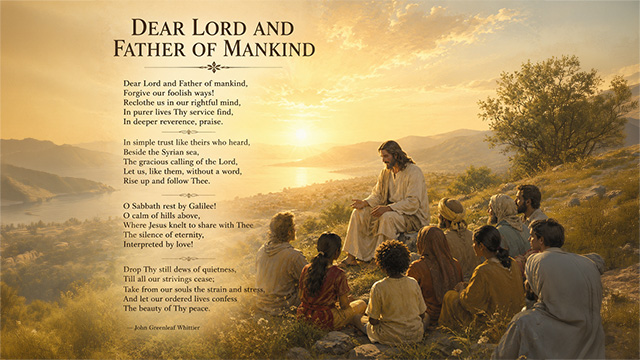
1. Dear Lord and Father of mankind, forgive our foolish ways; reclothe us in our rightful mind, in purer lives thy service find, in deeper reverence, praise.
2. In simple trust like theirs who heard, beside the Syrian sea, the gracious calling of the Lord, let us, like them, without a word, rise up and follow thee.
3. O sabbath rest by Galilee, O calm of hills above, where Jesus knelt to share with thee the silence of eternity, interpreted by love!
4. Drop thy still dews of quietness, till all our strivings cease; take from our souls the strain and stress, and let our ordered lives confess the beauty of thy peace.
5. Breathe through the heats of our desire thy coolness and thy balm; let sense be dumb, let flesh retire; speak through the earthquake, wind, and fire, O still, small voice of calm.
Story of the hymn Dear Lord and Father of Mankind
"Dear Lord and Father of Mankind" is a beloved Christian hymn with words by American Quaker poet John Greenleaf Whittier (1807–1892).Its text comes from the concluding stanzas of his longer 1872 poem "The Brewing of Soma," first published in The Atlantic Monthly.
Background on Whittier
Whittier was a prominent 19th-century American poet, journalist, and abolitionist from a rural Quaker family in Haverhill, Massachusetts. Quakers (Society of Friends) emphasize silent, contemplative worship and simplicity, generally avoiding elaborate rituals, music, or emotional excesses in religious settings. Whittier wrote the poem around age 65 as a critique of overly emotional or sensational forms of worship.He criticizes 19th-century Christian revival meetings, camp meetings, and emotional excesses that he saw as similar "intoxications" (including fanaticism, alcohol, or drugs). As a Quaker, he advocated for sober, reverent living and listening to the "still small voice" of God (echoing 1 Kings 19:11–13 in the Bible). The hymn text is typically taken from the final six stanzas (stanzas 12–17 in the original poem), turning the critique into a positive prayer for inner peace, forgiveness, and guidance.