Traditional Hymns
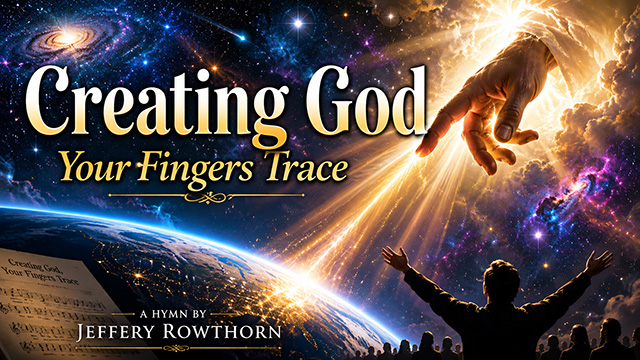
Creating God, Your Fingers Trace
Creating God, Your Fingers Trace
Listen to:
 Creating God, Your Fingers Trace (.midi) Creating God, Your Fingers Trace (.mp3) Creating God, Your Fingers Trace Bells Version (.mp3)
1. Creating God, your fingers trace the bold designs of farthest space; let sun and moon and stars and light and what lies hidden praise your might.
2. Sustaining God, your hands uphold earth's mysteries known or yet untold; let water's fragile blend with air, enabling life, proclaim your care.
3. Redeeming God, your arms embrace all now despised for creed or race; let peace, descending like a dove, make known on earth your healing love.
4. Indwelling God, your gospel claims one family with a billion names; let every life be touched by grace until we praise you face to face.
Story of the hymn Creating God, Your Fingers Trace
Background and Origin
Rowthorn, a Welsh-born Anglican priest, theologian, liturgist, and later Episcopal bishop, began writing hymn texts in 1974. This hymn was one of his earliest efforts. He wrote it as a fresh reflection on Psalm 148 (which calls all creation—heavenly bodies, elements of nature, and living creatures—to praise God). It is not a strict paraphrase but a new poetic text inspired by the psalm.The text won (one of two winners) in a Hymn Society of America contest for "New Psalms for Today." It was first published in The Hymn journal in April 1979, with copyright held by The Hymn Society.
Themes and Structure
The hymn has a strong Trinitarian structure, addressing God in three persons across its stanzas:Stanza 1: Creating God — Celebrates God as Creator, with vivid imagery of the cosmos ("your fingers trace the bold designs of farthest space"), echoing Psalm 8:3 ("the work of thy fingers, the moon and the stars").
Stanza 2: Sustaining God — Focuses on God's ongoing care for the earth and life (water, air, mysteries of nature).
Stanza 3: Redeeming God — Shifts to redemption, embracing the marginalized and calling for peace.
Stanza 4: Indwelling God — Emphasizes the Holy Spirit's presence and the hope of eternal praise.
It beautifully weaves together creation, providence, redemption, and eschatological hope, making it suitable for themes of creation care, Trinity Sunday, and general praise.