Traditional Hymns
For All the Saints
For All the Saints
Listen to:
 For All the Saints Piano (.mp3)
For All the Saints (.midi)
For All the Saints (.mp3)
For All the Saints Bells Version (.mp3)
For All the Saints Piano (.mp3)
For All the Saints (.midi)
For All the Saints (.mp3)
For All the Saints Bells Version (.mp3)
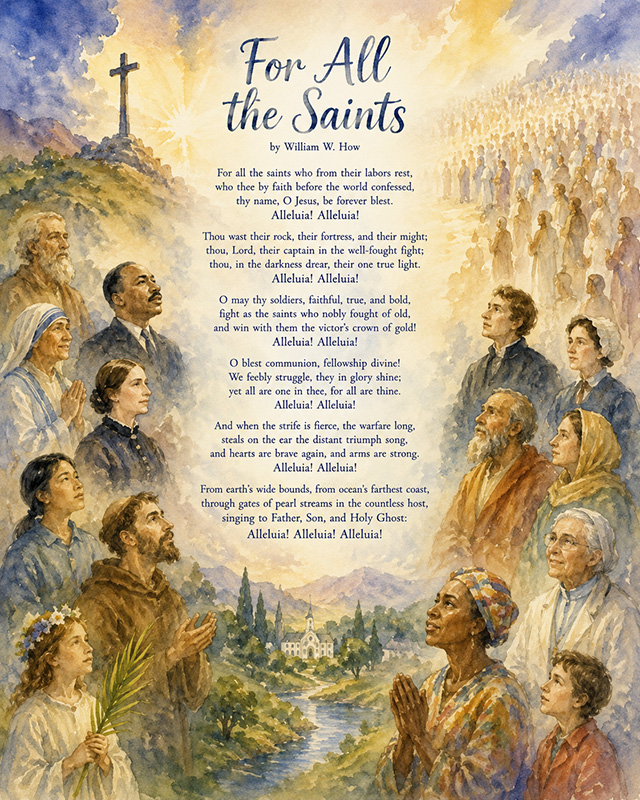
1. For all the saints, who from their labors rest, who thee by faith before the world confessed, thy name, O Jesus, be forever blest. Alleluia, Alleluia!
2. Thou wast their rock, their fortress, and their might; thou Lord, their captain in the well-fought fight; thou in the darkness drear, their one true light. Alleluia, Alleluia!
3. O may thy soldiers, faithful, true, and bold, fight as the saints who nobly fought of old, and win with them the victor's crown of gold. Alleluia, Alleluia!
4. O blest communion, fellowship divine! We feebly struggle, they in glory shine; yet all are one in thee, for all are thine. Alleluia, Alleluia!
5. And when the strife is fierce, the warfare long, steals on the ear the distant triumph song, and hearts are brave again, and arms are strong. Alleluia, Alleluia!
6. From earth's wide bounds, from ocean's farthest coast, through gates of pearl streams in the countless host, singing to Father, Son, and Holy Ghost: Alleluia, Alleluia!
Story of the hymn For All The Saints
William Walsham How was born in Shrewsbury, Shropshire, England. He studied at Wadham College, Oxford, and Durham University, and was ordained in the Church of England in 1847. He served as rector of Whittington, Shropshire, when he wrote the hymn. Later, he became a suffragan bishop in east London (1879) and Bishop of Wakefield (1888).He earned nicknames like the "poor man's bishop" and "the children's bishop" for his dedicated ministry among the destitute in London's slums and factory workers in west Yorkshire. How wrote numerous hymns (over 30 texts) and theological works. He engaged with controversies of his time, such as the Oxford Movement, and sought to reconcile biblical creation with evolutionary theory. He co-edited hymn collections like Psalms and Hymns (1854) and Church Hymns (1871).
Origins and Purpose of the Hymn
The hymn was first published in Hymns for Saints' Days, and Other Hymns (compiled by Horatio Nelson, 3rd Earl Nelson) in 1864. It was originally titled something like "For All Thy Saints" and headed with Hebrews 12:1 ("Therefore, since we are surrounded by so great a cloud of witnesses..."). It was designed as a processional hymn for All Saints' Day (November 1) and other saints' days in the liturgical calendar.The text originally had 11 stanzas of three lines each, ending with the refrain "Alleluia!" Many modern hymnals use 6–8 stanzas, often omitting specific ones about apostles, evangelists, and martyrs. How revised it over time (e.g., changing "For all Thy saints" to "For all the saints"). It reflects on the communion of saints—the connection between the Church Militant (believers on earth) and the Church Triumphant (saints in heaven). It draws from biblical imagery like the "great cloud of witnesses" (Hebrews 12:1), Revelation, and the idea that all saints (famous or unknown) rest in Christ after their labors. The hymn praises Christ for the saints' faithfulness and encourages the living to persevere.
Themes and Structure
It opens by blessing Jesus for the saints who confessed Him by faith. It portrays Christ as Rock, Fortress, Captain, and Light. It highlights fellowship between struggling believers on earth and glorified saints in heaven ("O blest communion, fellowship divine!"). It describes the ongoing spiritual battle and the ultimate triumphant procession into heaven. The hymn emphasizes that sainthood stems from faith in Christ, not personal heroism alone.Music and Popularity
Early on, it was paired with Joseph Barnby's tune Sarum (also called For All the Saints or St. Philip), from the Sarum Hymnal (1868). In 1906, Ralph Vaughan Williams composed the now-iconic tune Sine Nomine ("without name") for The English Hymnal. This majestic, unison-friendly melody (with some harmonized verses) is widely regarded as one of the greatest 20th-century hymn tunes and is the most common pairing today. The name may allude to unnamed or lesser-known saints. Charles Villiers Stanford also wrote a tune, Engelberg, in 1904, but it is less associated with this text now.The hymn is frequently sung on All Saints' Day, at funerals, memorial services, and other occasions celebrating the faithful departed. Its stirring tune and encouraging message have made it a staple in many Christian traditions (Anglican, Lutheran, Methodist, etc.). In summary, "For All the Saints" grew out of Bishop How's pastoral heart and liturgical focus, offering a profound meditation on the unity of all believers across time and eternity—anchored in Christ. It continues to inspire Christians by connecting the struggles of today with the victory of the saints who have gone before.