Traditional Hymns
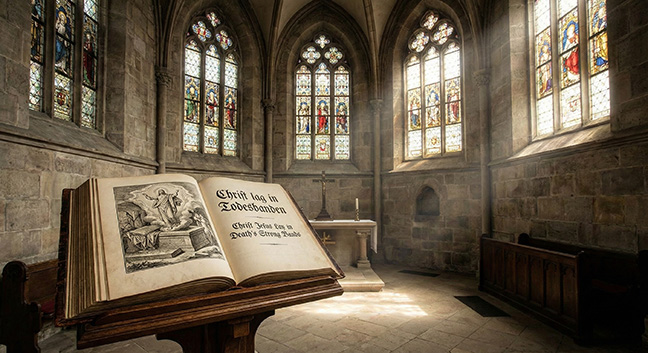
Christ Jesus Lay in Death's Strong Bands
Christ Jesus Lay in Death's Strong Bands
Listen to:
 Christ Jesus Lay in Death's Strong Bands (.midi) Christ Jesus Lay in Death's Strong Bands (.mp3) Christ Jesus Lay in Death's Strong Bands Bells Version (.mp3)
1. Christ Jesus lay in death's strong bands, for our offenses given; but now at God's right hand he stands, and brings us life from heaven; wherefore let us joyful be, and sing to God right thankfully loud songs of Alleluia! Alleluia!
2. It was a strange and dreadful strife when life and death contended; the victory remained wtih life; the reign of death was ended. Stripped of power, no more it reigns, and empty form alone remains; death's sting is lost forever! Alleluia!
3. So let us keep the festival whereto the Lord invites us; Christ is himself the joy of all, the Sun that warms and lights us. By his grace he doth impart eternal sunshine to the heart; the night of sin is ended! Alleluia!
4. Then let us feast this Easter day on the true bread of heaven; the Word of grace hath purged away the old and wicked leaven. Christ alone our souls will feed; he is our meat and drink indeed; faith lives upon no other! Alleluia!
Story of the hymn "Christ Jesus Lay in Death's Strong Bands"
The story of the hymn "Christ Jesus Lay in Death's Strong Bands" is deeply rooted in the Protestant Reformation and Martin Luther's efforts to bring vibrant, congregational singing back to worship.In 1524, amid the early whirlwind of the Reformation and following his famous Ninety-Five Theses in 1517, Martin Luther (1483–1546) was actively reforming the liturgy. He sought to replace the Latin Mass with services in the vernacular German language, where ordinary people could fully participate, including through singing. This was revolutionary at a time when only choirs typically sang in church.
Luther wrote the hymn "Christ lag in Todesbanden" ("Christ lay in death's bonds") specifically for Easter, drawing inspiration from ancient sources. Its text is Luther's own "improved" and expanded reworking of an older German Easter folk song, "Christ ist erstanden" ("Christ is arisen"), which itself traced back to the medieval Latin Easter sequence "Victimae paschali laudes" (from the 11th century, attributed to Wipo of Burgundy).The story of the hymn "Christ Jesus Lay in Death's Strong Bands" is deeply rooted in the Protestant Reformation and Martin Luther's efforts to bring vibrant, congregational singing back to worship.