Traditional Hymns
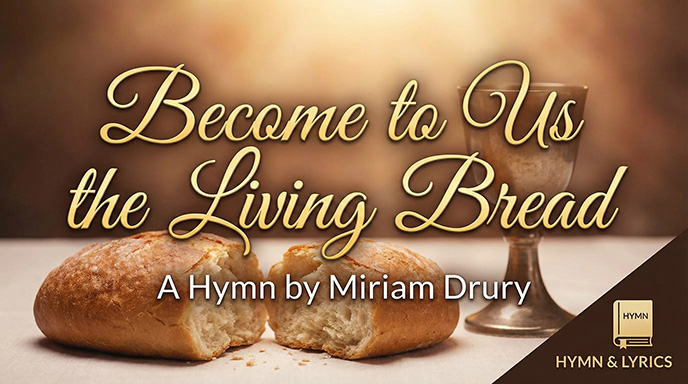
Become to Us the Living Bread
Become to Us the Living Bread
Listen to:
 Become to Us the Living Bread (.midi) Become to Us the Living Bread (.mp3) Become to Us the Living Bread Bells Version (.mp3)
1. Become to us the living bread by which the Christian life is fed, renewed, and greatly comforted. Alleluia! Alleluia! Alleluia!
2. Become the never-failing wine, the spring of joy that shall incline our hearts to bear the covenant sign. Alleluia! Alleluia! Alleluia!
3. May Christians all with one accord unite around the sacred board to praise your holy name, O Lord. Alleluia! Alleluia! Alleluia!
Story of the Hymn Become to Us the Living Bread
Miriam Drury was an American hymnwriter, composer, poet, and organist born in Santa Ana, California. She spent most of her life in California, attending the University of California and serving as an organist in her local Congregational church during her youth.
In 1922, she married Clifford Merrill Drury, a Presbyterian minister and professor of church history at San Francisco Theological Seminary. The couple had three children, which inspired much of her early work in children's hymns, poems, anthems, and songs. She composed complete hymns (both words and music) for both children and adults throughout her life. Later, after retirement, she resided in the Monte Vista Presbyterian Retirement Home in Pasadena, California.
Drury was an active member of the Hymn Society in the United States and Canada (formerly the Hymn Society in America) and won multiple awards in their hymn-writing contests. Her works often reflected themes of faith, unity, and sacrament, drawing from biblical imagery.
The hymn "Become to Us the Living Bread" (sometimes titled "Become for Us the Living Bread") was written in 1970 and emerged as one of her most enduring contributions. It won an award in a 1970 contest sponsored by the Hymn Society, specifically for new Communion hymns. The text is deeply rooted in John 6:35–58, where Jesus declares, "I am the living bread that came down from heaven" (John 6:51, NIV).
The hymn emphasizes the Eucharist as spiritual nourishment, renewal, covenant, and Christian unity—themes resonant in the post-Vatican II era (following the Second Vatican Council, 1962–1965), which promoted ecumenical dialogue and shared worship.
Drury incorporates the archaic phrase "sacred board" (referring to the Communion table), reviving a term from earlier 19th-century American hymns. The "Alleluia" refrain in each stanza makes it especially suitable for Eastertide celebrations of Holy Communion or World Communion Sunday.